
Rubik's Cube notation: every move letter explained
Learn Rubik's Cube notation in 5 minutes. Every move letter (R, U', F2, M, x) with a small moving cube, a full table, and a quick quiz to test yourself.
Cube notation is a short code for turns. Each letter is one face of the cube, and a mark after the letter tells you which way to turn it. Learn it once and you can read any algorithm on any site.
What notation is and why it exists
A solution for the cube is a list of turns. Writing "turn the right side down, then the top to the left" for every turn would take pages. So cubers use one letter per face. The system most sites use is called Singmaster notation, named after David Singmaster, the mathematician who made it popular. Our beginner tutorial uses the same letters, so this page is a good first stop.
The six faces
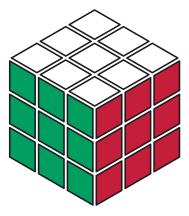
Every face gets a letter from its position, not from its color. F is the face that looks at you. R is on your right, L on your left, U is up, D is down, and B is the back face. The colors in the table are the usual ones, but if your cube has blue in front, then blue is F for you.
| Letter | Face | Usual color | Clockwise means |
|---|---|---|---|
| Front, the face looking at you | Green | Like a clock on the front face | |
| Right | Red | The front column goes up | |
| Up, the top | White | The front row goes to the left | |
| Back, away from you | Blue | Clockwise when seen from behind | |
| Left | Orange | The front column goes down | |
| Down, the bottom | Yellow | The front row goes to the right |
Clockwise is always judged while you look straight at that face. That is why R and L look like they go in opposite directions in space: you would see them from opposite sides. A trick we use when teaching kids: turn the cube so the face you need looks at you, make the turn like a clock hand, then turn the cube back. After a week your hands remember it and you can skip that step. 😊
The pieces: centers, edges and corners
The letters name faces, but a turn moves pieces. A 3x3 cube has 26 pieces you can see, in three kinds. Cubers name each piece with the same face letters, so once you know the faces, you can name any piece too.
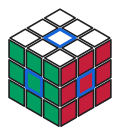
Centers: 6 pieces, 1 sticker each
A center sits in the middle of a face. A face turn only spins it in place, so the centers never move relative to each other: white is always opposite yellow, green opposite blue and red opposite orange. The center sets the color of its face, and it is named by that face alone: the U center, the F center. Only slice moves and rotations move a center to another spot.
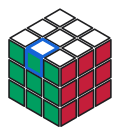
Edges: 12 pieces, 2 stickers each
An edge sits between two centers and is named by those two faces. The white-green edge belongs in the UF spot, between the top and the front. An edge can be in its spot but flipped, with its two colors the wrong way round. Every face turn moves four edges.
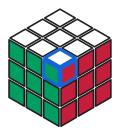
Corners: 8 pieces, 3 stickers each
A corner sits where three faces meet and is named by all three. UFR is the corner at the top, front and right, where the white, green and red centers meet. A corner can be in its spot but twisted, with its colors turned around it. Every face turn moves four corners.
A piece never changes kind: an edge stays an edge and a corner stays a corner wherever it goes. So when an algorithm "swaps two corners" or "flips two edges", you know which pieces to watch while it plays. The beginner tutorial solves them in that order: the white edges first, then the white corners.
Face turns: the plain letter, the apostrophe and the 2
Each face has three moves. The plain letter (R) is a quarter turn clockwise. The letter with an apostrophe (R', said "R prime") is a quarter turn counterclockwise. The letter with a 2 (R2) is a half turn, and for that one the direction does not matter. Press play on a cube below to watch the plain move. Tap a letter to try it on the simulator.
These 18 moves are all you need for the beginner method. The full list of beginner and 2-look algorithms uses nothing else, except a few M moves in two PLL cases.
Slice moves: M, E and S
A slice move turns only the middle layer between two faces. There are three of them, and each one copies the direction of a face turn. M is the layer between L and R, and it turns the same way as L. E is the layer between U and D, and it follows D. S is the layer between F and B, and it follows F. The odd one is M: most people expect it to follow R, so check the player before you trust your memory. 👀
M (middle)
Turns like L. The white center goes to the front.
E (equator)
Turns like D. The green center goes to the right.
S (standing)
Turns like F. The white center goes to the right.
Wide moves and cube rotations
A wide move turns two layers at once: the face and the slice next to it. It is written as a lowercase letter (r) or with a w (Rw). Both mean the same thing on a 3x3. The Speedsolving wiki notation page lists the wide moves for bigger cubes too, where the number of layers matters.
A rotation turns the whole cube in your hands. No piece moves relative to another, so a rotation is not really a move, but algorithms use it to bring a face to a handy spot. x rotates the cube like an R turn, y like a U turn and z like an F turn.
r (wide right)
Same as R and M' together.
x
Whole cube in the R direction. Green goes to the top.
y
Whole cube in the U direction. Red comes to the front.
z
Whole cube in the F direction. Orange goes to the top.
How to read an algorithm
An algorithm is just a row of these moves, read from left to right. Take the most famous one, often called the "sexy move":
Read it as: right face up, top layer to the left, right face down, top layer to the right. Do it 6 times in a row and the cube comes back to where it started. Sites write this repeat as (R U R' U')x6 or (R U R' U')6: the part in brackets is done 6 times. Try it on the full screen simulator and count the repeats. 🧩
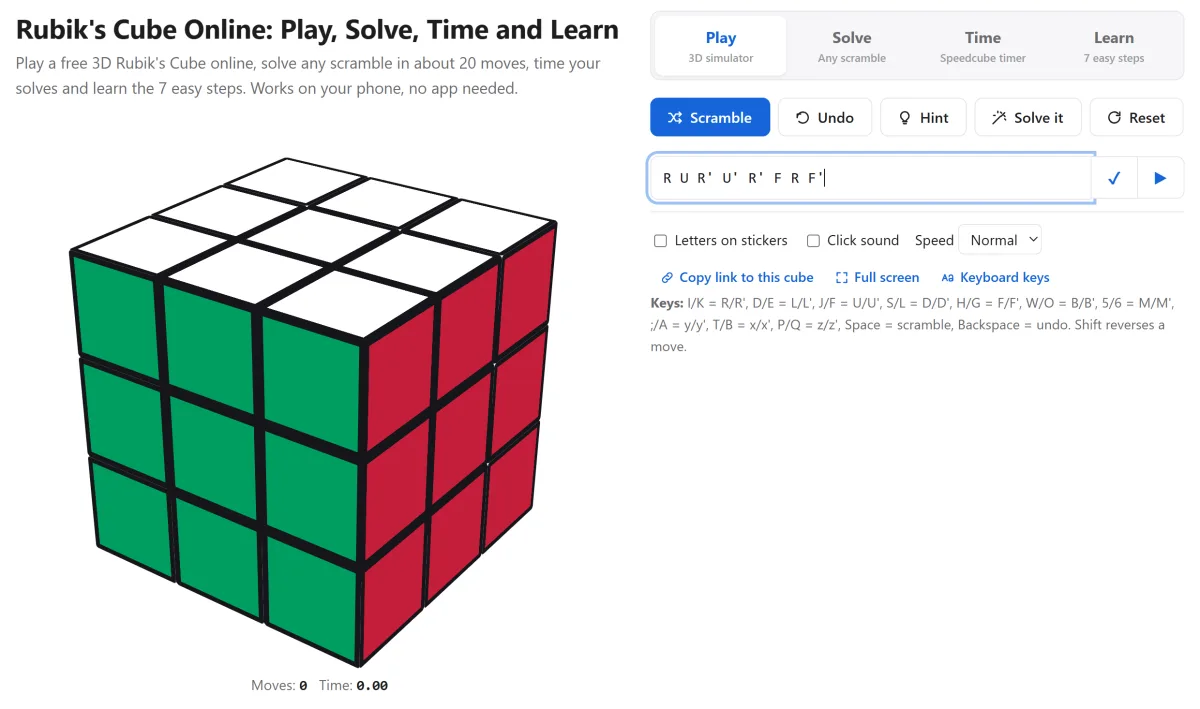
- A space between moves is normal but not required: R U R' U' and RUR'U' are the same.
- Some sites write R2' for a half turn done counterclockwise. It ends in the same place as R2.
- A number after a bracket is a repeat: (R U)3 means R U R U R U.
- Old books sometimes write R-1 or R^-1 instead of R'. Same move.
Quick quiz: name the move
The cube makes one move. Pick the right letter.
Questions people ask
What does the apostrophe mean?
The apostrophe means counterclockwise, as seen while looking at that face. R' is "R prime": turn the right face a quarter turn so the front column moves down. On its own it undoes R.
Is R2 clockwise or counterclockwise?
It does not matter. A half turn ends in the same place either way, so turn it the way that feels better in your hand. Fast cubers pick the direction that sets up the next move.
What is a wide move?
A wide move turns two layers together: the face and the middle slice next to it. On a 3x3, r is the same as R plus M'. Wide moves show up in OLL algorithms because they are fast to do with one finger.
Why do some sites write Rw and others r?
They are two spellings of the same move. The WCA regulations use Rw in official scrambles, and the lowercase r is a shorter style that most algorithm sites prefer. Our parser accepts both.
What is HTM vs QTM?
They are two ways to count moves. In HTM (half turn metric) every face turn counts as one move, so R2 is one move. In QTM (quarter turn metric) R2 counts as two. God's number is 20 in HTM and 26 in QTM, as explained on Ruwix's God's number page. Slice moves count as one in STM (slice turn metric) and two in HTM.
Ready to use the letters? Scramble the cube on the home page, press Hint, and read each move out loud as it plays.
Last updated: November 6, 2026