
What you can do here
The Rubik's Cube has 43 quintillion possible positions. That sounds scary, but you only need 7 steps and a few short move patterns to solve it. The cube above is one cube with four tools around it. Scramble it in Play, press Solve, and the solver already knows the same state. 🧩
- Play: turn a 3D cube with your mouse or finger. The full screen cube has the same controls with more room.
- Solve: paint your real cube and get a solution in about 20 moves. The solver page explains every error message.
- Time: a speedcubing timer with inspection, ao5 and ao12. The timer page adds sessions, charts and csTimer import.
- Learn: the 7 step beginner method, with a moving cube for each step. The full tutorial goes deeper.
There is nothing to install and no account to make. Everything runs in your browser, on a phone too.
How to play with the cube
Drag a sticker to turn that side. Drag the empty space next to the cube to spin the whole cube and look at the back. On a phone, do the same with one finger. Scroll or pinch to zoom.
If you prefer the keyboard, each key is the letter of the move: R turns the right side, U the top, F the front. Hold Shift to turn the other way, so Shift+R is R'. Space gives you a new scramble and backspace undoes a move. The full key list is on the play page.
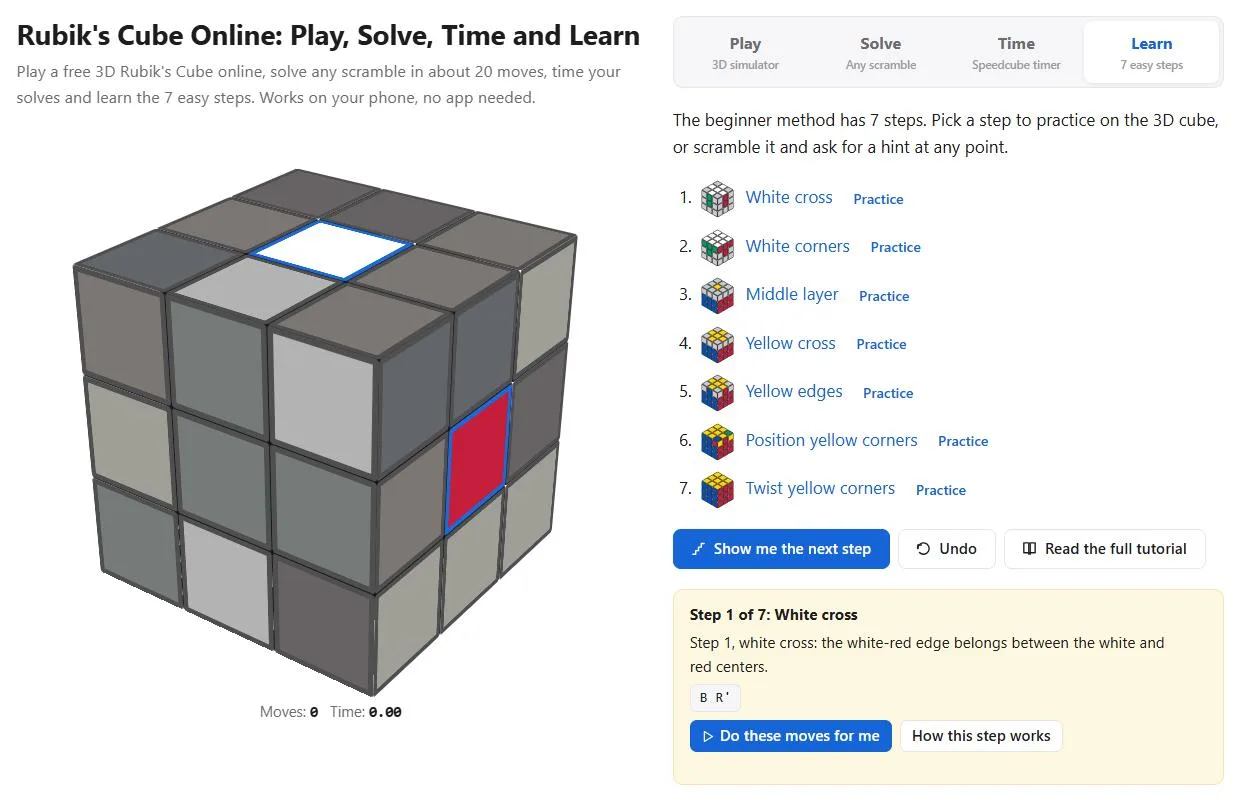
Stuck? Press Hint. The cube finds which of the 7 steps you are at, makes the pieces you need glow, and tells you what to do in one sentence. Press it again and it plays the next few moves slowly. This is the button we wish we had when we started. 😊

Try this four-move pattern first. Cubers call it the "sexy move" because it shows up in so many algorithms. R means turn the right side clockwise, U the top, and the apostrophe means counterclockwise. Do it six times and the cube is back where it started. The notation page explains all the letters.
How the solver finds a solution in about 20 moves
Every one of those 43 quintillion positions can be solved in 20 moves or fewer. This number is called God's number. Tomas Rokicki, Herbert Kociemba, Morley Davidson and John Dethridge proved it in 2010, with about 35 CPU-years of computer time donated by Google. The whole story is on cube20.org.
Finding the true shortest solution for one position still takes a lot of computing. Our solver uses a shortcut from 1992 called the Kociemba two-phase algorithm. It finds a solution of about 20 moves in a fraction of a second, right in your browser. Ruwix's page on God's number explains why 20 moves is always enough. The solver has two modes.
| Mode | Fast | Teach me |
|---|---|---|
| Length | About 20 moves | About 120 moves |
| Method | Kociemba two-phase | The 7 step beginner method |
| Good for | Getting the cube solved now | Learning, each step is labeled |
| Time to compute | Under a second | Under a second |
| Can you follow along? | Yes, with the step player | Yes, and you see why each move is made |
Time your solves like at a competition
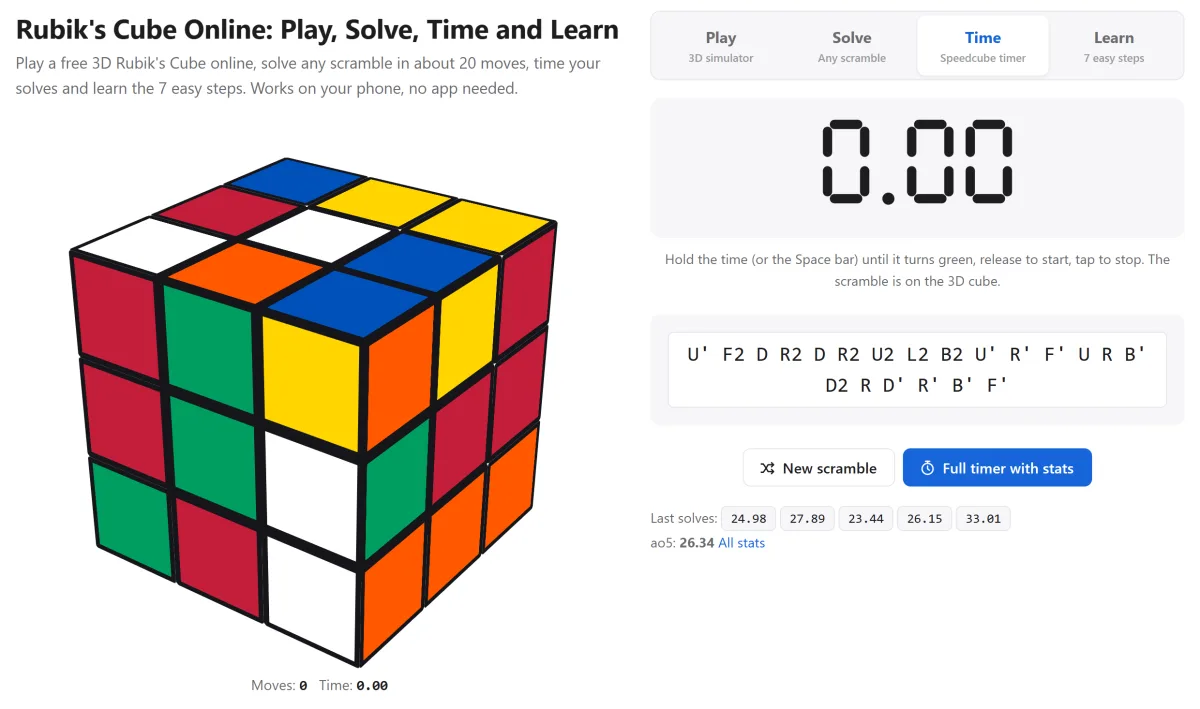
Hold the space bar until the time turns green, let go to start, and hit any key to stop. On a phone, hold your finger on the timer. Turn on inspection and you get the same 15 seconds as at a real competition. The WCA Regulations add 2 seconds if you start between 15 and 17 seconds. After 17 seconds the solve does not count.
Cubers rarely talk about single times. They talk about ao5, the average of 5. Take five solves, drop the best and the worst, and take the mean of the other three. One lucky solve does not help you, and one bad one does not hurt. Your times stay in your browser; nothing is sent to us. The timer page explains every stat.
Learn in 7 steps
Our beginner method solves the cube layer by layer. You build the white cross first, then the white corners, then the middle layer. The yellow side comes last, in four small steps. You need to remember five short move patterns in total. Most people get their first solve in an afternoon with the tutorial open. 🎉
Each step in the how to solve guide has a moving cube, the moves you need and a practice button that sets up the cube above at exactly that step. Our team's average with this method is about 1:30, and under a minute is realistic after a few weeks.
A few cube facts
Erno Rubik, a Hungarian architect and professor, built the first working cube in 1974 in Budapest. He wanted a model that shows how parts can move on their own while the whole thing holds together. He applied for a patent in 1975, and the first batches reached toy shops in Budapest in 1977 under the name Magic Cube.
| Year | What happened |
|---|---|
| 1974 | Erno Rubik builds the first working prototype in Budapest |
| 1977 | The Magic Cube goes on sale in Hungary |
| 1980 | Renamed Rubik's Cube and sold worldwide by Ideal Toy |
| 1982 | First World Championship in Budapest, won by Minh Thai in 22.95 seconds |
| 2010 | God's number is proved: every position needs at most 20 moves |
The cube is made of 26 small blocks that turn around a hidden center cross, as Britannica describes it. Around 500 million cubes have been sold since 1977. The fastest people solve it in a blink: the world record single is 2.51 seconds, set by Xuanyi Geng in October 2026. The current record is on the WCA records page.
Ready? Scramble the cube above, press Hint, and start with the white cross.
Questions people ask
Is this the official Rubik's Cube app?
No. RubiksCu.be is a free, independent fan site made by a small team of cubers who code. We are not affiliated with, sponsored by or endorsed by the Rubik's brand or any cube maker. When we say "Rubik's Cube" we mean 3x3x3 twisty cubes in general: the tools work with any 3x3 cube, whatever name is on the box. More on our about page.
Does it work on my phone?
Yes. The 3D cube, the solver and the timer all work with touch. The flat view of the solver is made for small screens.
Do I need to install anything?
No. Everything runs in the browser you already have. There is no app, no account and no sign up. Your timer data stays on your device.
Can it solve any scramble?
Yes, any real position of a 3x3 cube. If a sticker is painted wrong, the solver tells you which piece to check instead of guessing. Positions that cannot exist on a real cube, like a single twisted corner, are caught before solving.
Is it free?
Yes, all of it. A few ads pay for the server. There is no paid version and nothing is locked.
Can every cube really be solved in 20 moves?
Yes. That is what the 2010 proof of God's number showed. Our Fast mode usually lands at 19 to 22 moves, because finding the exact shortest path for every position would take far more computing than a browser can do in a second.
Last updated: November 4, 2026